AERO – AIR SOURCE HEAT PUMPS
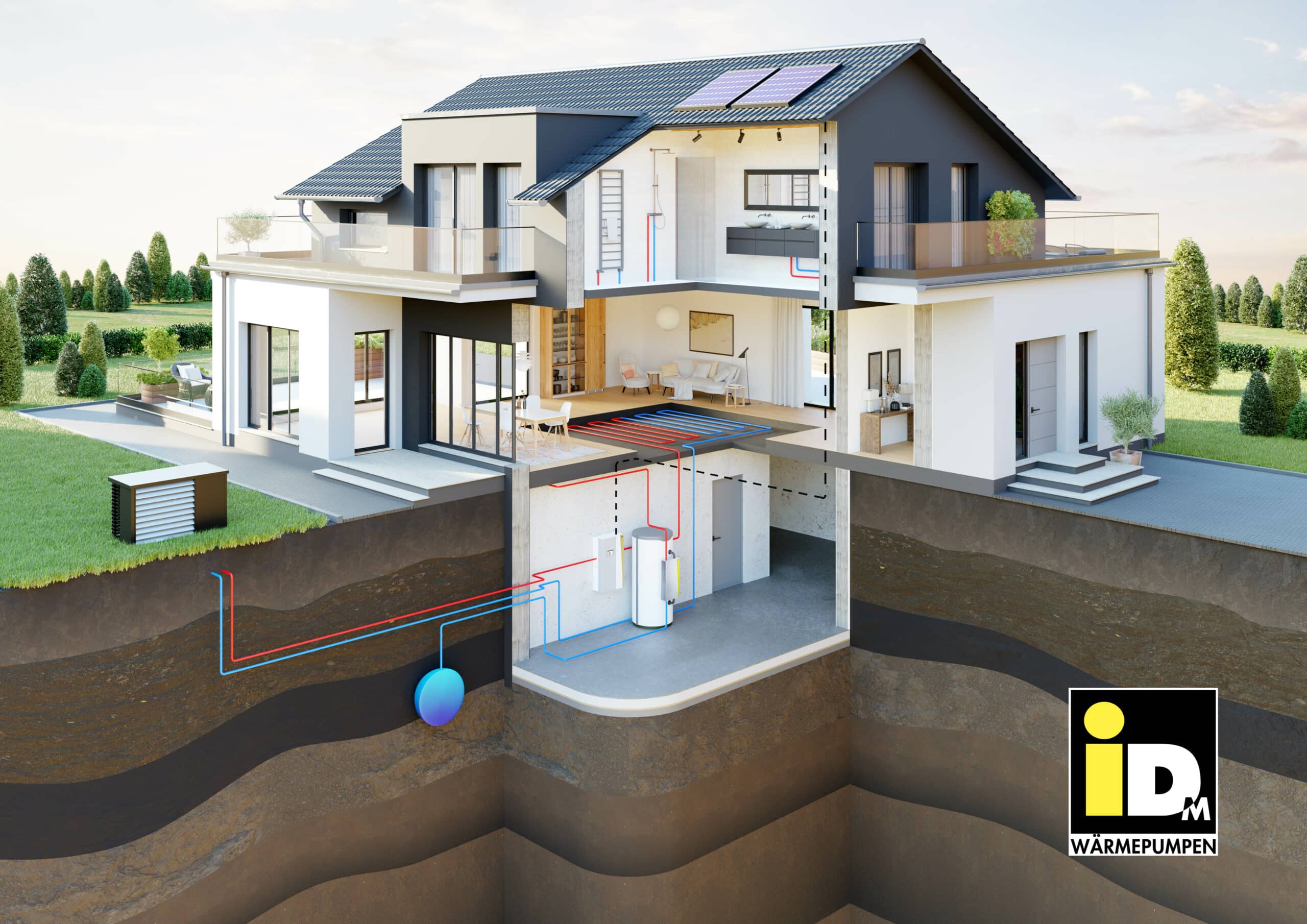
An air source heat pump is an electrically-driven heating and cooling device that extracts renewable thermal energy from the outdoor air. Manufactured by iDM Energiesysteme GmbH in Matrei in Osttirol, Austria, the iDM AERO series achieves this using a highly efficient vapour-compression cycle. Our AERO models provide an output range from 2 kW to 50 kW and proudly carry the highest A+++ EU energy label class. Whether you are planning a new build or a retrofit renovation, these systems are perfectly suited for domestic hot water preparation, space heating, and active cooling in single-family houses, apartments, and commercial buildings. Let’s explore how air source heat pumps work, the different types available, and why the iDM AERO is the right choice for your property.
OUR PRODUCTS
How does an air source heat pump work?
An air source heat pump extracts thermal energy from outdoor air using a vapour-compression refrigeration cycle. A refrigerant absorbs heat in the evaporator, the compressor raises its temperature, and the condenser transfers heat to the building’s heating circuit — even at outdoor temperatures down to −20 °C.
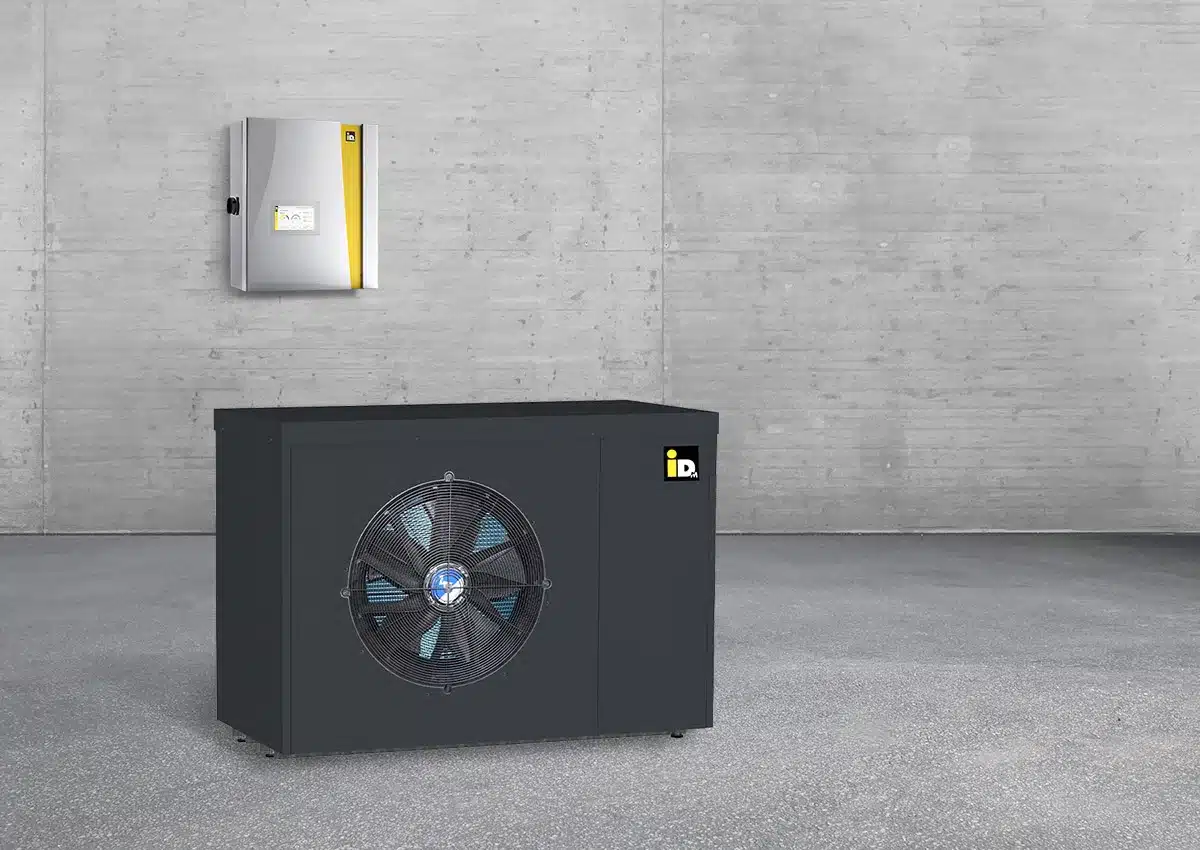
First, the outdoor unit draws in ambient air, passing it over an evaporator. Inside, a liquid refrigerant absorbs the air’s latent heat and turns into a gas. Second, an inverter compressor squeezes this gas, significantly increasing its pressure and temperature. Third, the hot gas travels to the condenser, where it transfers its heat to your building’s heating circuit. Finally, an expansion valve reduces the pressure, turning the refrigerant back into a cool liquid so the cycle can begin again.
Because we are transferring existing heat rather than burning fuel, the useful heat output is typically 3 to 5 times greater than the electrical input consumed by the compressor, a concept known as the Coefficient of Performance (COP).
If you would like to explore the thermodynamics in more detail, you can learn how the air source heat pump refrigeration cycle works.
Types of Air Source Heat Pumps
When exploring your options, it is helpful to understand the primary types of air source heat pumps on the market.
-
Air Source Heat Pump Air to Water: This is the most common and efficient type for central heating, and the category that the iDM AERO series falls into. It extracts heat from the air and transfers it to water, which is then circulated through compatible emitters like underfloor heating, low-temperature radiators, and domestic hot water (DHW) cylinders.
-
Monobloc vs. Split Systems: Installation types generally fall into two categories. Monobloc heat pumps contain all refrigeration components within a single outdoor unit, transferring water directly into the home. Split heat pumps divide the components between an outdoor unit and an indoor unit, connected by refrigerant lines.
How efficient is an iDM AERO air source heat pump?
The iDM AERO series achieves a Seasonal Coefficient of Performance (SCOP) of up to 4.5 under EN 14511 test conditions, meaning it produces 4.5 kWh of heat for every 1 kWh of electricity consumed. This earns the highest A+++ EU energy label classification.
We measure system performance using the Coefficient of Performance (COP) and the Seasonal Coefficient of Performance (SCOP). While COP gives you a snapshot of efficiency, SCOP calculates the average efficiency over an entire heating season, making it the most meaningful metric for real-world running costs.
Because our units feature stepless inverter modulation, the compressor adjusts its output continuously, which avoids wasteful on/off cycling losses and ensures high seasonal efficiency. For example, a 10 kW system operating with a SCOP of 4.5 will produce 45,000 kWh of equivalent heat over a season while only drawing 10,000 kWh of electricity. Under the ErP directive, this performance secures the A+++ energy efficiency class.
| Test Condition (EN 14511) | SCOP | EU Energy Label |
|---|---|---|
| A7/W35 | 4.5 | A+++ |
| A2/W35 | 3.8 | A+++ |
| A-7/W35 | 2.9 | A++ |
You can maximise efficiency further by pairing your system with the iDM NAVIGATOR smart energy management system. For a deeper dive into these metrics, read our guide on understanding COP and SCOP in heat pump efficiency.
At what temperatures does an air source heat pump operate?
iDM AERO air source heat pumps operate in outdoor temperatures from −20 °C to +43 °C, making them suitable for Alpine climates and Central European winters. Cold-climate inverter models maintain effective heating output even during severe frost events.
A common question is whether a heat pump works reliably in winter. Because we manufacture our systems in Tyrol, Austria, we deeply understand Alpine climate conditions.
Heat pumps rely on a performance curve: as the outdoor ambient air gets colder, the system works slightly harder. However, our cold climate heat pumps extract usable heat even when temperatures plummet. The typical operating temperature range spans from −20 °C to +43 °C. For extreme cold days, a bivalent setup or backup heater ensures your home stays warm.
| Outdoor Ambient Temperature | Example Heat Output | COP |
|---|---|---|
| +7 °C | 10 kW | 4.5 |
| +2 °C | 8 kW | 3.8 |
| -7 °C | 6.5 kW | 2.9 |
Example performance table.
What refrigerant does the iDM AERO use, and why does it matter?
iDM AERO heat pumps use R32 refrigerant, which has a Global Warming Potential (GWP) of 675 — 68% lower than the legacy R410A refrigerant. R32 also delivers higher volumetric efficiency, enabling more compact units with the same heat output.
The refrigerant inside your heat pump is crucial for environmental impact. Our iDM AERO systems primarily utilise R32 refrigerant (GWP 675), and select models offer R290 propane, an ultra-low option with a GWP of just 3.
Compared to legacy R410A (GWP 2088), R32 represents a massive step forward in sustainability. This aligns with the EU F-gas regulation 2024 phase-down timeline, ensuring your investment is future-proofed. Safety is paramount; R32 has an A2L classification, meaning it is safely managed by F-gas certified professionals during standard installations.
Which iDM AERO model is right for my building?
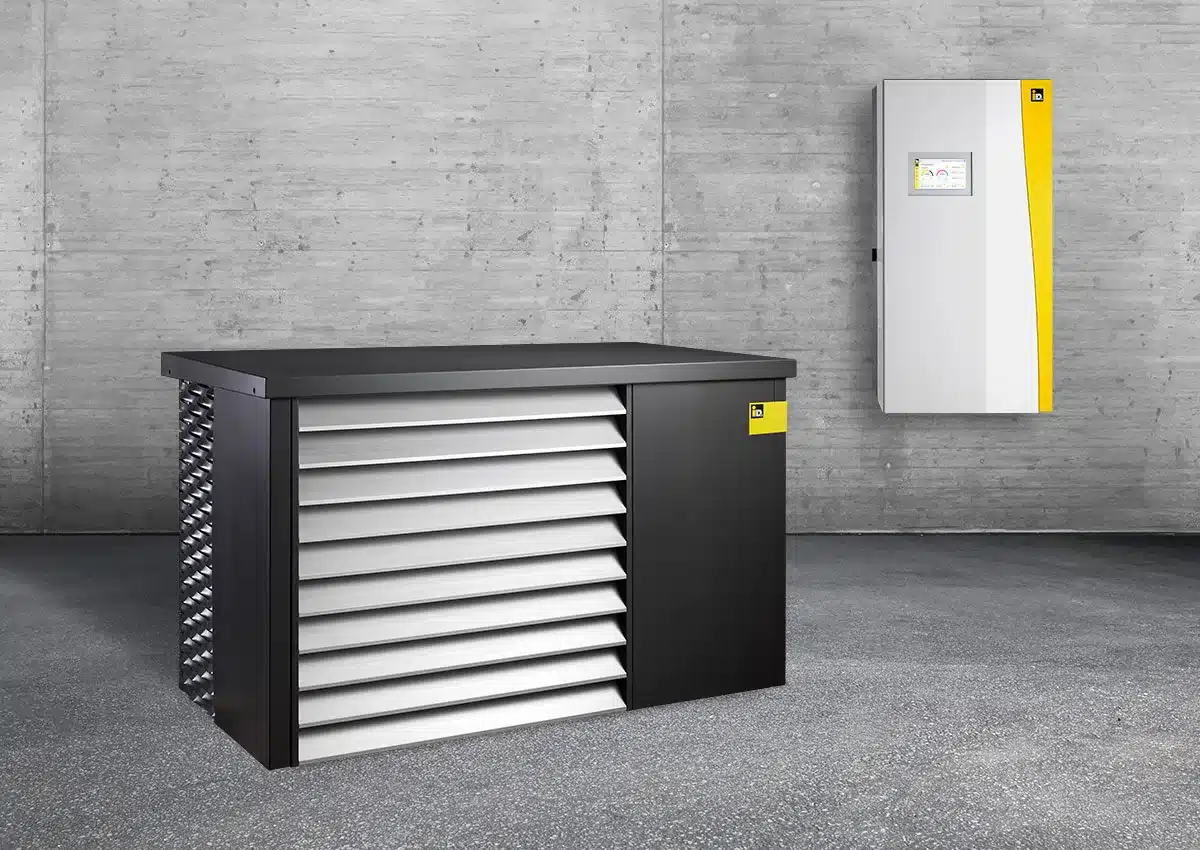
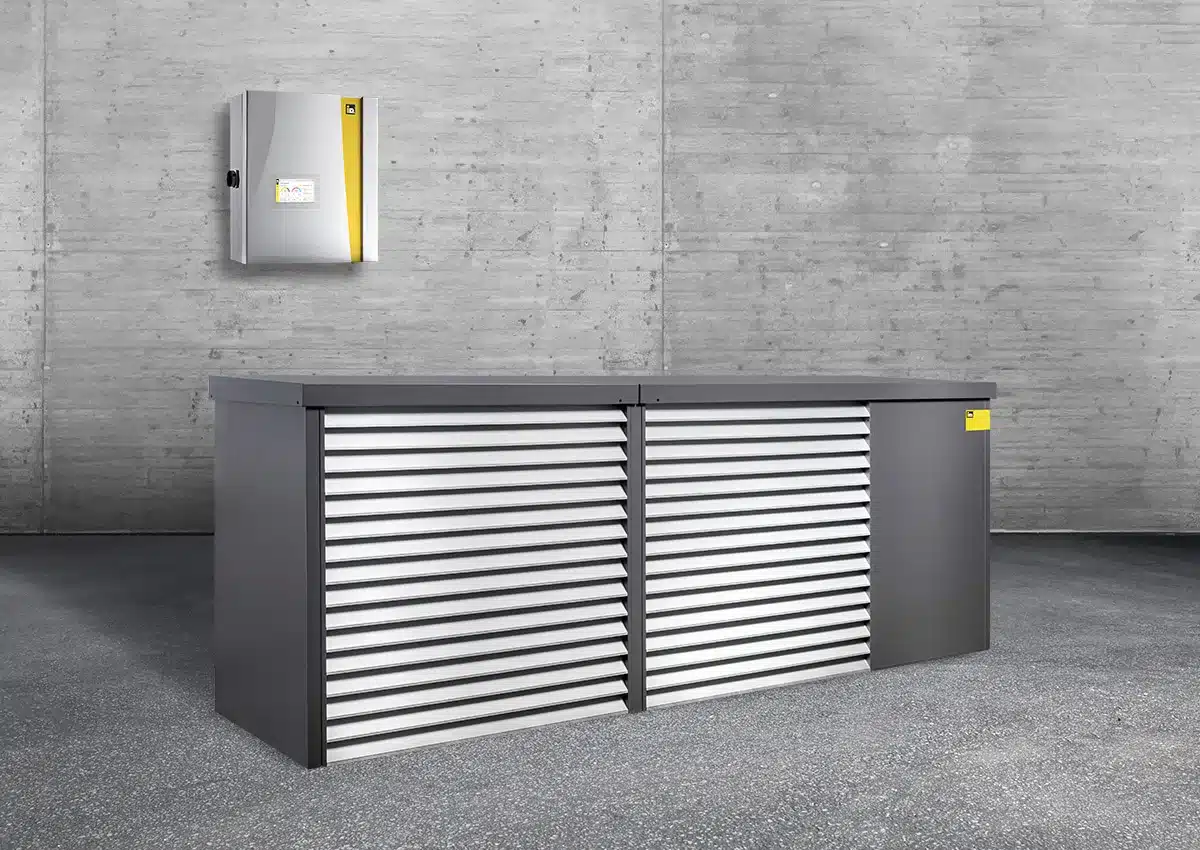
The right iDM AERO model depends on your building’s heat load: AERO ALM (2–24 kW) suits most single-family homes, AERO SLM (3–17 kW) fits smaller residential properties, AERO ALM MAX (10–50 kW) covers larger buildings, and AL TWIN cascades up to 160 kW for commercial applications.
Finding the perfect match begins with a heat load calculation (typically estimated as W/m² × floor area). For instance, a 180 m² house in Austria typically requires an 8–12 kW system. We advise contacting a certified iDM installer to get a professional calculation.
Model Selector Guide
- Residential Use: For new builds or retrofits, the ALM or SLM series provide the ideal output range.
- Commercial/Large Residential: High demands require the ALM MAX or the AL TWIN, which utilizes cascade operation for up to 160 kW.
| Model | Output Range | Ideal Building Type | Key Differentiator |
|---|---|---|---|
| iDM AERO ALM air source heat pump (2–24 kW) | 2 – 24 kW | New build & retrofit residential | Perfect adaptation to individual heat requirements via stepless modulation |
| iDM AERO SLM modulating heat pump (3–17 kW) | 3 – 17 kW | Smaller residential | Efficient heating, cooling, and DHW for moderate heat demand |
| iDM AERO ALM MAX large heat pump (10–50 kW) | 10 – 50 kW | Commercial & multi-family | Large output in modulating format — avoids costly multi-unit setups |
| iDM AL TWIN cascade heat pump (up to 160 kW) | 32 kW per unit | Large commercial | Scalable cascade architecture for high-demand applications |
Is an air source heat pump worth the investment? Running costs and savings
An air source heat pump typically costs 30–60% less to run than a gas boiler, depending on local electricity and gas tariffs. In Austria, with available Sanierungsbonus subsidies covering up to 50% of installation costs, most homeowners achieve payback within 6–10 years.
To understand the true value, evaluate the lifecycle cost, which includes the purchase price, installation, and running cost.
For example, if a 180 m² home requires 15,000 kWh of heating annually, a 12 kW AERO ALM operating at a SCOP of 4.0 will consume roughly 3,750 kWh of electricity. At an electricity tariff of €0.25/kWh, the savings compared to a gas boiler are substantial.
Furthermore, EU taxonomy and energy price forecasts heavily favour electrification. Air source heat pump government grants—like the Austrian, German, and Italian Sanierungsbonus and “Raus aus Öl” subsidies—significantly lower the upfront installation cost. These factors typically bring the payback period down to an estimated 6–10 years. Learn more about the Austrian, German, and Italian Sanierungsbonus and heat pump funding.
Air Heat Source Heat Pump Pros and Cons (Advantages vs Disadvantages)
To help you evaluate your decision, here is a clear look at the pros and cons of air source heat pumps :
| Advantages (Pros) | Disadvantages (Cons) |
|---|---|
| Lower Running Costs: Generally costs 30-60% less to run than traditional gas boilers. | Upfront Cost: Higher initial purchase price than a gas boiler (though offset by subsidies). |
| Environmentally Friendly: 3–4× lower CO₂ emissions than a gas boiler on the EU average grid mix. | Space Requirements: Requires outdoor space for the unit, with specific setback distances. |
| Easier Installation: Fitting air source heat pump systems is faster and much cheaper than ground source alternatives. | Noise Regulations: Units generate sound, requiring careful placement to adhere to dB(A) limits. |
| Reversible Cooling: Capable of active cooling during the summer months. | Efficiency Drops in Extreme Cold: COP decreases slightly during severe frost events compared to ground source. |
How quiet is an iDM AERO air source heat pump?
The iDM AERO series produces between 42 and 62 dB(A) sound power level depending on the model and operating mode, comparable to a quiet conversation. Austrian and German noise regulations typically require heat pump sound pressure levels below 35 dB(A) at the property boundary.
When discussing noise, it is helpful to distinguish between the sound power level (the noise the unit makes) and the sound pressure level (what you actually hear from a distance).
Tested under the EN 12102 standard, the AERO series ranges from 42 to 62 dB(A). To give you an idea, 42 dB(A) is similar to a quiet library, while 55 dB(A) is like a normal conversation. To adhere to strict Austrian noise regulations (like the Oö. Bautechnikgesetz) and ensure you meet planning permission rules without disturbing neighbours, your installer will help calculate the necessary setback distance to keep the sound pressure below 35 dB(A) at your property line. Many models also offer a quiet night mode.
How long does an iDM air source heat pump last, and what maintenance is required?
iDM air source heat pumps are designed for a service life of 20+ years. Annual professional servicing — checking refrigerant charge, electrical connections, and filter condition — ensures optimal performance and protects the manufacturer’s warranty.
We engineer our systems for longevity. While the compressor is the primary wear component, the expected lifespan is 15 to 25 years.
Air source heat pump installation and fitting air source heat pump units must be handled by professionals, and the same goes for upkeep.
Annual Maintenance Checklist:
- Clean or replace system filters.
- Check the refrigerant charge.
- Inspect electrical connections.
Maintenance must be performed by F-gas certified engineers to satisfy regulatory requirements and protect your warranty. We highly recommend booking through our partner network for iDM certified heat pump service and maintenance. You can review full details in our air source heat pump installation requirements and process guide.
How does an air source heat pump compare to a ground source heat pump?
Air source heat pumps extract energy from ambient air and require only an outdoor unit, making them faster and cheaper to install than ground source heat pumps, which need ground loops or boreholes. Ground source typically achieves higher SCOP but at 2–3× higher installation cost.
A frequent question is whether a garden is large enough for a ground source heat pumps (GSHP). While GSHPs—like our iDM TERRA geothermal heat pumps for ground-source heating — offer incredible efficiency, they require significant land for ground loops or borehole permits.
As a rule of thumb: ASHPs are ideal for retrofits and properties with smaller plots, while GSHPs excel in new builds with ample land.
| Feature | Air Source (ASHP) | Ground Source (GSHP) |
|---|---|---|
| Heat Source | Ambient Air | Ground/Earth |
| Installation Cost | Lower | 2-3x Higher |
| Space Required | Small Outdoor Area | Large Garden / Boreholes |
| Planning Permission | Usually Simpler | Permits Required |
You can compare heat sources: air, ground, and water heat pumps in our detailed guide.
Can an air source heat pump provide cooling as well as heating?
Yes. iDM AERO air source heat pumps are reversible: in summer, the refrigeration cycle is reversed to extract heat from the building and reject it outside, providing passive or active cooling. Active cooling can maintain indoor temperatures between 18 °C and 26 °C.
Our AERO models are reversible heat pumps, meaning they offer year-round indoor climate control. In summer, the refrigeration cycle reverses to expel indoor heat outside.
You can utilise passive cooling (which uses very low energy) or active cooling, which operates much like traditional air conditioning to maintain temperatures between 18 °C and 26 °C. This cooling function is highly efficient when distributed through underfloor heating or fan coil units. Note that EU F-gas regulations require your installer to carry specific cooling certifications.