How Does a Heat Pump Work?
A heat pump is an electrically driven thermal-energy transfer system. It collects low-temperature heat from outdoor air, the ground, groundwater or a recoverable technical source, raises that heat to a useful temperature and releases it into a building. The same system can provide space heating, domestic hot water—potable water used at taps and showers—and, when designed for it, cooling. Most delivered heat is transferred from the environment rather than produced from electricity alone.


What does a heat pump do?
A heat pump transfers existing thermal energy from a cooler source to a warmer building circuit. Electricity drives this transfer, while environmental heat supplies most of the useful output. The system can provide space heating, domestic hot water and cooling.
The heat source is the place from which the system collects low-temperature energy. Outdoor air, soil, rock, groundwater and recoverable waste heat can all serve as sources. The heat sink is the destination that receives useful heat, normally a water-based heating circuit, hot-water store or process load.
A heat pump does not burn oil, gas or biomass inside the building. Its electrical input powers the compressor, circulation equipment and controls that move and upgrade heat. On-site combustion emissions are therefore absent during operation, while upstream emissions depend on how the electricity is generated.
A direct electric heater converts electricity into heat at the point of use. A heat pump uses electricity to transfer additional energy from its surroundings, which is why useful heat output can exceed electrical input. A refrigerator applies the same broad principle in the opposite practical direction: it removes heat from a cold compartment and releases that heat into the room.
How does a heat pump move heat into a building?
A heat pump circulates refrigerant through a loop between the heat source and the building. The refrigerant collects low-temperature heat, an electrically powered compressor raises its usable temperature, and heat exchangers transfer energy without mixing the source and heating-water circuits.
At system level, the energy path is simple:
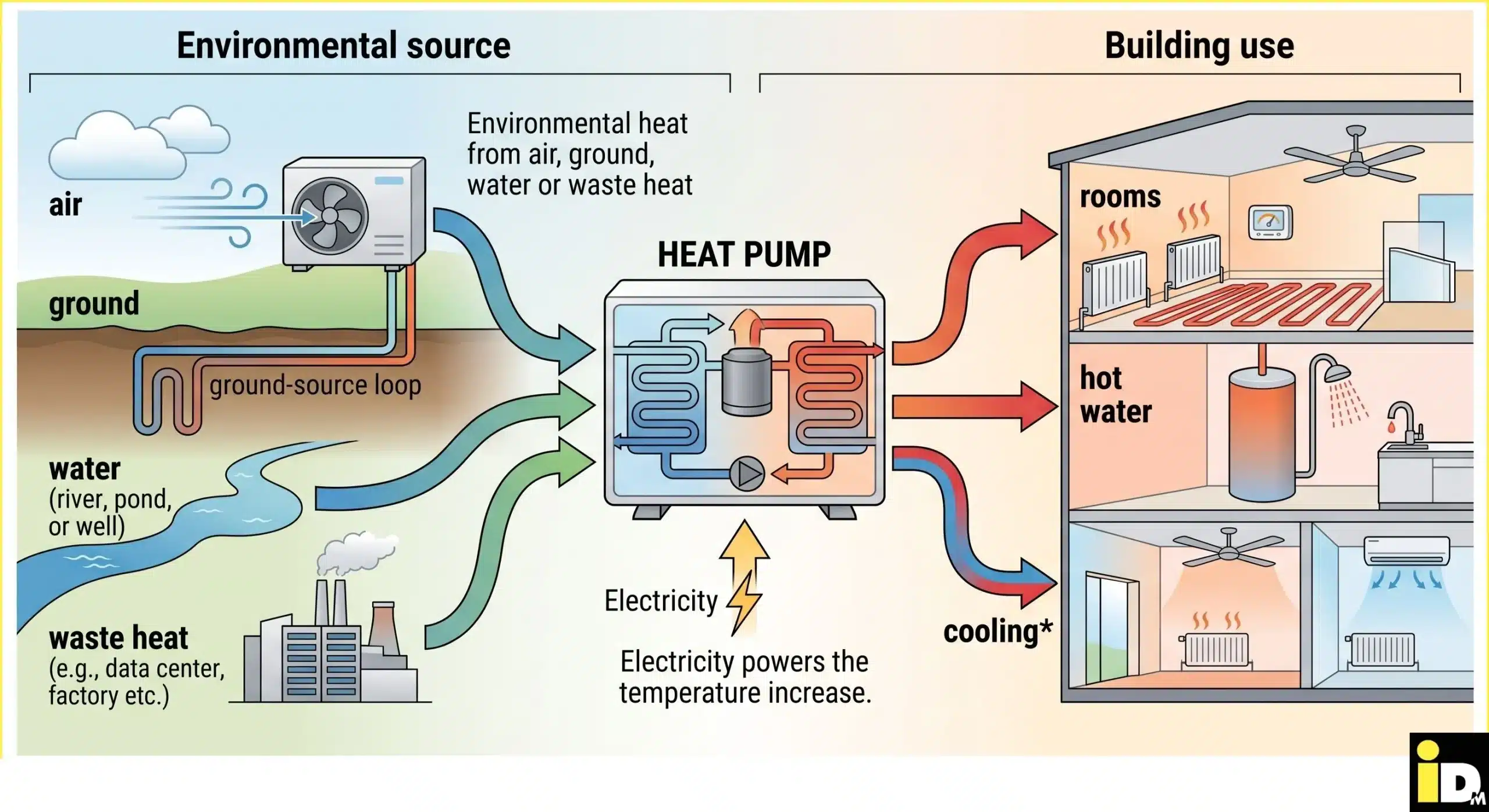
The closed loop contains four principal functional parts: an evaporator, a compressor, a condenser and an expansion device. Their combined role is to collect heat, raise its temperature, release it to the building and prepare the working fluid to collect heat again.
The refrigerant is the working fluid that carries heat around this sealed circuit. Changes in its pressure allow heat to be absorbed at a lower temperature and released at a higher temperature.
The underlying pressure, temperature and phase relationships form the heat pump’s thermodynamic cycle.
Where does a heat pump collect environmental heat?
A heat pump can collect low-temperature energy from outdoor air, soil, rock, groundwater, surface water, waste heat or an engineered energy loop. The selected source determines source-side equipment, installation work, seasonal temperature stability, site requirements and the suitable heat-pump category.
The heat source changes how energy reaches the refrigerant, but it does not change the heat pump’s fundamental purpose. Each source supplies thermal energy that the system upgrades and transfers into the building.
| Heat source | Heat-pump category | Source-side arrangement | Main project consideration |
| Outdoor air | Air-to-water heat pump | Outdoor heat exchanger and fan | Placement, airflow, sound and changing outdoor temperatures |
| Soil or rock | Brine-to-water heat pump | Closed collector or borehole circuit | Available land, drilling or excavation and source design |
| Groundwater | Water-to-water heat pump | Extraction and return wells or an approved water circuit | Water availability, quality, pumping energy and permissions |
| Waste heat or energy loop | Project-specific water-source heat pump | Shared low-temperature network or recoverable technical source | Network temperatures, load diversity and system responsibility |
Air-source systems collect energy directly from outdoor air and avoid ground-source drilling. Ground and groundwater systems use source infrastructure with temperatures that tend to vary less across the heating season. The correct choice depends on the property rather than on a universally superior source.
A heat emitter is the room-side device that releases heat, such as underfloor heating, a radiator or a fan coil. The source type does not dictate the emitter: air, ground and water-source heat pumps can serve each option when output, water temperatures and hydraulic design match the building.
Why can a heat pump deliver more heat than the electricity it uses?
A heat pump combines environmental heat with electrical work, so useful heat output exceeds purchased electricity. At a coefficient of performance of four, one kilowatt-hour of electricity supports about four kilowatt-hours of heat delivery under the stated specific operating conditions.
The energy relationship is:
Useful heat delivered = environmental heat collected + electrical energy used
The coefficient of performance, abbreviated COP, is the useful heat output divided by the electrical input at a defined operating condition. A COP of 4 means that 1 kWh of electricity accompanies approximately 4 kWh of useful heat, with the balance collected from the source. The International Energy Agency uses a COP of around four as a typical household example, not as a guaranteed value for every system.
COP changes with operating conditions. An annual performance factor divides annual useful heat by annual electrical input. Its measurement boundary defines which equipment, such as source pumps or backup heating, is included. Product test values and a building’s measured annual result therefore answer different questions.
A simple purchasing estimate can use annual useful heat demand divided by an expected annual performance factor. A hypothetical building requiring 12,000 kWh of useful heat would use about 3,000 kWh of electricity at an annual factor of 4.0. This calculation is an estimate, not a prediction of the installed result.
What affects heat-pump efficiency?
Heat-pump efficiency depends on source temperature, required heating-water temperature, system sizing, auxiliary electricity, controls and building demand. A smaller temperature difference between source and delivery reduces compressor work, while correct hydraulics and stable operation protect seasonal performance throughout the year.
The temperature lift is the difference between the available source temperature and the temperature required by the building. Flow temperature is the temperature of heating water leaving the heat pump. A smaller lift and lower necessary flow temperature reduce compressor work and support efficiency.
| Efficiency factor | Relationship to performance |
| Source temperature | A warmer source reduces the required temperature lift |
| Flow temperature | A lower required heating-water temperature reduces compressor work |
| System sizing | Capacity matched to demand supports stable operation during reduced demand |
| Heat distribution | Suitable emitters and hydraulic balance reduce unnecessary temperatures |
| Auxiliary electricity | Fans, pumps and backup heating affect total system consumption |
| Control settings | Heating curves, schedules and priorities determine actual operating conditions |
Hydraulic balancing adjusts water flow so each heat emitter receives its calculated share. Radiators do not automatically exclude a heat pump. The decisive questions are how much heat each room needs and what water temperature the installed emitters require to provide it.
Variable-speed compressors can adjust output as building demand changes, reducing unnecessary on-off operation within the equipment’s operating range.
Efficiency also depends on the complete heating system rather than on the heat pump alone. Source pumps, fans, distribution pumps, storage, backup heat, domestic-hot-water settings and control behaviour all affect measured electricity use. A professional design must therefore define the measurement boundary before comparing performance values.
How can one heat pump provide heating, hot water and cooling?
A heat pump directs useful heat to room heating or domestic-hot-water storage, depending on demand. Reversible systems can move heat out of the building for cooling, while suitable ground-source installations directly transfer heat to the ground without active compressor operation.
For space heating, the condenser transfers heat into the building’s water circuit. That water then supplies underfloor heating, radiators, wall heating or fan coils. The heat pump produces the required flow temperature according to outdoor conditions, room demand and control settings.
For domestic hot water, the system charges an integrated or separate store, or supplies a fresh-water heat exchanger. Hot-water production normally requires a higher target temperature than low-temperature space heating, so the operating point and efficiency differ. iDM’s iPUMP family combines a heat pump with integrated domestic-hot-water storage.
For active cooling, a reversible heat pump changes the direction of useful heat transfer and moves heat from the building to the available sink. For passive cooling, suitable ground or groundwater systems circulate cool source energy through heat exchangers without using the compressor for cooling production. Cooling design must match the building’s heat emitters, temperatures and control strategy.
Heating, hot water and cooling share equipment, but they do not have identical temperature requirements or operating priorities. Control logic coordinates these services so that comfort demand, available capacity, storage and system limits remain aligned.
How does an air-source heat pump operate during winter?
An air-source heat pump continues collecting energy below freezing because outdoor air still contains thermal energy. Colder conditions increase the required temperature lift and can reduce output or efficiency, so design temperature, building load, placement and system sizing remain essential.
The Austrian Energy Agency reported in July 2026 that modern heat pumps operate efficiently at low temperatures and are increasingly applicable in existing buildings. This statement supports cold-climate suitability, but it does not replace project-specific performance data at the local winter design condition.
Cold, humid weather can produce frost on an air-source unit’s outdoor heat exchanger. The heat pump then performs an automatic defrost process to restore airflow and heat transfer.
Outdoor-unit planning must account for unrestricted airflow, snow, safe condensate routing, service access and acoustics. These are installation requirements, not changes to the underlying heat-transfer principle. Professional site assessment is especially important in Alpine and densely built locations.
Which iDM heat-pump fits each application?
iDM Energiesysteme GmbH, an Austrian heat-pump manufacturer, organizes solutions by source, integration level and building scale. AERO uses outdoor air, TERRA uses ground or groundwater, iPUMP integrates hot-water storage, MAX serves larger loads, and NANO supports decentralized apartment-based renovation concepts.
The table identifies family-level application fit rather than comparing model specifications. Output, refrigerant, flow temperature, sound data and cooling functions must be verified on the current product page and technical documentation for the selected model.
| iDM family | System concept | Typical application direction |
| AERO Air Source Heat Pumps | Air-source heat-pump family | Homes, renovations and larger projects where outdoor air is the practical source. |
| TERRA Geothermal Heat Pumps | Ground or groundwater heat-pump family | Projects with a suitable collector, borehole or groundwater source. |
| iPUMP Heat Pumps With Hot Water Tank | Heat pump with integrated domestic-hot-water storage | Residential projects seeking a compact, integrated indoor solution. |
| MAX Large Heat Pumps | Large-capacity and cascade-capable systems | Hotels, residential complexes, commercial buildings and industrial applications. |
| iDM NANO | Decentralized apartment heat pumps connected to a shared source concept | Multi-storey renovation and district projects requiring apartment-level supply and accounting. |
AERO systems use outdoor air as the source. TERRA systems use energy from the ground or groundwater. iPUMP describes integrated hot-water solutions available across relevant source concepts. MAX covers larger buildings and capacity requirements, while NANO addresses apartment-level heat-pump deployment within multi-unit renovation.
What information is needed before choosing a heat pump?
Heat-pump selection starts with building data rather than a catalogue model. The design must establish heat load, available source, required water temperatures, hot-water demand, cooling objectives, electrical capacity, acoustic constraints, hydraulic arrangement, controls and the conditions for commissioning and measurement.
A professional assessment covers six decision areas:
- Building demand: Calculate the design heat load—the heating power required at the local winter design temperature—and understand annual space-heating and hot-water demand.
- Heat source: Confirm air-unit placement or the feasibility of ground, groundwater or shared-loop infrastructure.
- Heat distribution: Check emitter output, required flow temperatures, hydraulic balance and zoning.
- Additional services: Define hot-water comfort, cooling requirements, storage and backup strategy.
- Site conditions: Verify electrical capacity, plant space, access, sound, drainage and applicable permissions.
- Commissioning: Record control settings, flow rates, meter boundaries, documentation and operator handover.
A comparable proposal states the selected model, performance at relevant design conditions, intended flow temperatures, sound data, electrical requirements, hydraulic scope, hot-water assumptions, control functions and commissioning responsibilities. A headline efficiency value alone cannot answer these project questions.
Estimated annual electricity use can be calculated as useful heat demand divided by the expected annual performance factor, provided both values use the same services and measurement boundary. Operating cost then depends on metered electricity, the applicable tariff, fixed charges, maintenance and any backup energy.
Current incentives, electricity prices and installation costs vary by date, country, region and property. A dated Austrian or DACH project calculation is therefore more reliable than a generic payback promise.
What questions do buyers ask after learning how heat pumps work?
Buyers ask about radiators, continuous operation, buffer tanks, winter performance, electricity use and power interruptions. These questions concern system application rather than the basic heat-transfer principle, so concise answers support orientation while specialist pages and project design provide necessary detail.
Can a heat pump work with radiators?
Yes. Suitability depends on room heat load, radiator output and the required water temperature. Lower temperatures support efficiency, while buildings requiring elevated temperatures need a documented retrofit assessment.
Does a heat pump need to run continuously?
Long, steady operation can be normal during the heating season because a correctly controlled system follows ongoing building demand. Runtime alone does not determine efficiency. Electricity input, heat output, temperature settings and cycling data provide more useful evidence.
Does every heat pump need a buffer tank?
No. A buffer tank is selected for a defined hydraulic or storage function, such as minimum system volume, hydraulic separation, zoning or short-term load shifting. The heat-pump manufacturer’s hydraulic scheme and the building system determine whether it is required.
Does a heat pump create heat?
A heat pump transfers and upgrades existing thermal energy. Electrical work raises the useful temperature, but the delivered heat also includes energy collected from air, ground, water or another source.
What happens during a power interruption?
The compressor, pumps and controls require electricity, so heat-pump operation stops when the electrical supply is unavailable. The building then cools according to outdoor conditions, insulation, internal gains and thermal mass. Critical facilities need a separately engineered continuity strategy.
How can performance be checked after installation?
Measure useful heat output and electrical input across a clearly defined boundary, then compare operation with the design assumptions. Flow temperatures, backup-heater use, cycling, hot-water settings and error history help explain deviations. The klimaaktiv guide recommends documented acceptance and commissioning as part of a quality installation.
What is the next step toward an iDM heat-pump system?
The next step is a building-specific configuration based on heat load, source conditions, delivery temperatures and comfort requirements. Gather energy records, plans and emitter information, then use the iDM configurator or contact a qualified partner to develop a matched proposal.
The operating principle is consistent across applications: a heat pump collects environmental heat, uses electricity to raise its usable temperature and transfers that energy into the building. Investment performance depends on matching this process to the source, building load, distribution temperatures and control strategy.
Homeowners can prepare annual energy records, floor plans and information about radiators or underfloor heating. Facility managers can add load profiles, operating schedules, hot-water demand, cooling requirements and electrical-capacity data. Contractors can use those inputs to define verifiable design conditions and select the appropriate iDM family and model.